

Scaling Acceptance Rates with Dynamic Personalization
Read Now Scaling Acceptance Rates with Dynamic Personalization Most LinkedIn connection requests get ignored. Not because your offer is bad. Not because your profile needs
Enjoy Lifetime Access to Hour Tag for Just $39!
Most LinkedIn outreach looks like this: you spend a few motivated hours sending connection requests, a reply comes in a week later, you scramble to follow up, the conversation dies, and you start the cycle again from scratch.
That’s not a lead engine. That’s a series of one-off attempts dressed up as a strategy.
A predictable lead engine works differently. It runs continuously, generates warm conversations on a consistent schedule, and compounds over time — without requiring you to manually push it forward every day. This article walks through exactly how to build one on LinkedIn, from the foundational structure to the automations that keep it running.
Unpredictability in LinkedIn outreach usually comes down to one of three problems:
No consistent input. Outreach happens in bursts — when there’s time, when pipeline is low, or when someone on the team is feeling motivated. The moment pressure drops, so does activity.
No structured follow-up. The connection request goes out and gets accepted. Nothing happens next. Or a follow-up message is sent days later with no clear thread connecting it to the original ask.
No feedback loop. Campaigns run without tracking what’s working. There’s no data on acceptance rates, reply rates, or which message variants perform — so nothing improves over time.
A real lead engine solves all three by replacing manual decisions with a repeatable system.
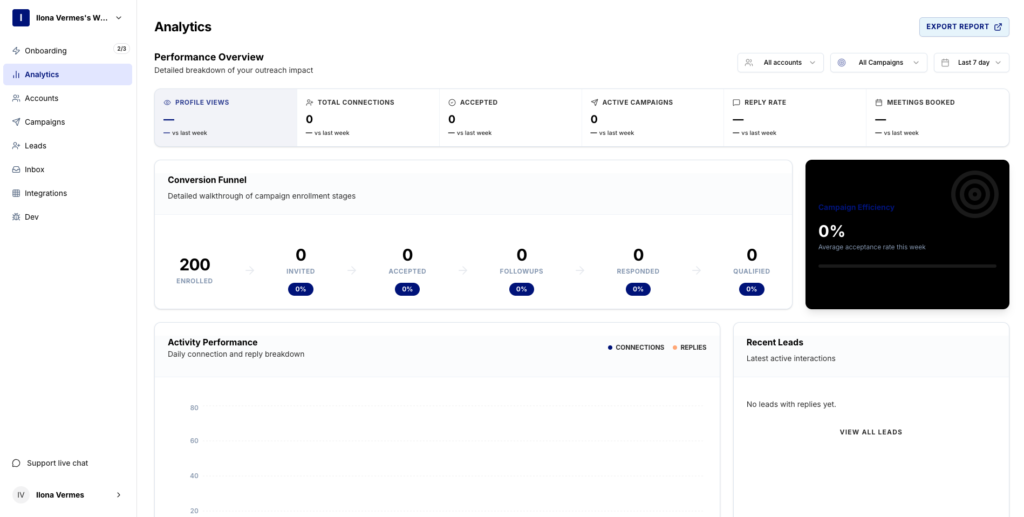
Your Pikeah dashboard gives you a real-time overview of every campaign running — connections sent, acceptance rates, and replies, all in one place.
Everything starts with who you’re reaching out to. A lead engine is only as good as the list feeding it.
The best-performing outreach campaigns start with tight segmentation — not “people in marketing” but “VP-level marketers at B2B SaaS companies with 50–200 employees.” The narrower your segment, the more specific your messaging can be, and the higher your acceptance and reply rates will be.
LinkedIn Sales Navigator is the most powerful source for this. You can filter by job title, seniority, industry, company size, geography, and even recent activity like job changes. Build separate lists for separate segments — don’t mix a founder audience with an enterprise buyer audience in the same campaign.
With Pikeah, you can import directly from Sales Navigator searches or custom lists into your campaign dashboard, skipping the manual copy-paste step entirely.
A single connection request is not a campaign. A lead engine runs on sequences — a structured series of touchpoints that unfold automatically after someone accepts your connection request.
A simple but effective structure looks like this:
The goal isn’t to close on message one. It’s to start a conversation that naturally progresses toward a call, a demo, or a reply that signals interest. Each step should feel like a logical continuation of the last — not a cold reset.
This is where most LinkedIn automation strategies fall apart. Tools that run from cloud servers — using data center IPs far from your actual location — are easy for LinkedIn’s systems to detect. The result is connection throttling, warning messages, or full account restrictions.
A safer approach is browser-based automation. Pikeah runs as a Chrome Extension directly in your browser, using your local IP address and your real session. This means the activity looks identical to manual behavior from LinkedIn’s perspective.
On top of that, a well-built lead engine includes protective logic:
Without these guardrails, volume alone becomes a liability. With them, you can run outreach at scale for months without account issues.
A lead engine without measurement is just automation running blind. The feedback loop — tracking what’s working and adjusting accordingly — is what turns a static campaign into a compounding system.
The metrics that matter most at each stage:
Tracking these numbers by campaign and by message variant lets you run structured A/B tests — not gut-feel tweaks. Over time, small improvements at each stage compound dramatically. Moving acceptance rate from 30% to 45% and reply rate from 15% to 25% doesn’t just add leads linearly — it multiplies them.
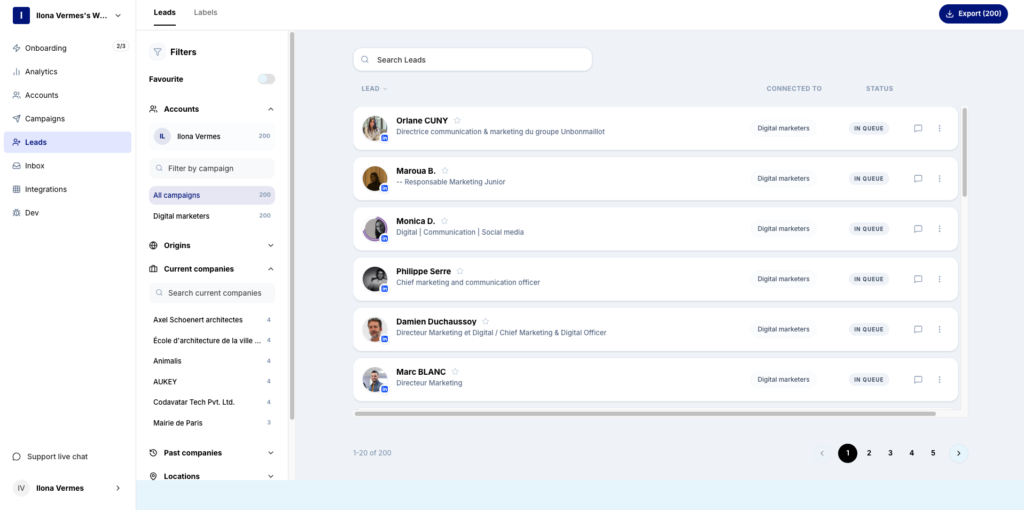
Import your leads directly from a LinkedIn or Sales Navigator search URL — Pikeah pulls the profiles automatically so you can jump straight into outreach.
A predictable lead engine doesn’t mean the same number of leads every single week. It means that your inputs — the number of new leads entering the sequence, the quality of your segmentation, the cadence of your drip — produce consistent, foreseeable outputs over a rolling 30-day window.
When the system is calibrated, you stop asking “where is my next lead coming from?” and start asking “how do I increase throughput?” That’s a fundamentally different position to be in.
For most solopreneurs and small sales teams, a well-built LinkedIn lead engine — running at a safe, sustainable volume — can generate 10 to 30 qualified conversations per month without any additional manual prospecting. For agencies running multiple client campaigns, that number scales accordingly.
Skipping segmentation. Broad targeting feels like more opportunity. It produces more noise and lower conversion at every stage. Tight segments outperform every time.
Sending one message and calling it a campaign. Most replies come from follow-up messages, not the first touchpoint. If your sequence stops at the connection request, you’re leaving most of your pipeline on the table.
Ignoring the data. Running campaigns for weeks without reviewing acceptance and reply rates means repeating mistakes at scale. Check your metrics weekly, not monthly.
Prioritizing volume over safety. Sending 150+ requests per day on a fresh account is a fast path to restriction. Build up gradually, respect the limits, and the engine runs longer.
Building a predictable LinkedIn lead engine is a systems problem, not a hustle problem. The goal isn’t to manually outwork your competition — it’s to design a machine that runs consistently in the background while you focus on closing the conversations it generates.
The four components — a segmented lead source, a multi-step sequence, safe automation, and a closed feedback loop — aren’t complicated individually. What makes them powerful is running them together, continuously, with the data to improve over time.
That’s what Pikeah is built to support: not just automation, but the entire system, from import to reply detection to analytics, in a single tool that protects your account while it works.
Read Now Scaling Acceptance Rates with Dynamic Personalization Most LinkedIn connection requests get ignored. Not because your offer is bad. Not because your profile needs

Read Now Building a Predictable LinkedIn Lead Engine Most LinkedIn outreach looks like this: you spend a few motivated hours sending connection requests, a reply

Read Now Why Browser-Based Tools Outperform Cloud Automation If you’ve ever had a LinkedIn account restricted, warned, or outright banned while using an automation tool,